


Standing before a packed chapel, Deanna Lynn spoke not as a distant expert but as someone who has lived the reality she now works to dismantle.
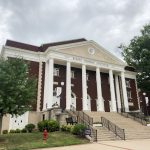
Lynn, the Kentucky executive director of Refuge for Women, returned to Sheridan Chapel more than a decade after first speaking there to share a message centered on Christian freedom, human dignity and the responsibility that comes with both. Drawing from Galatians 5 and her own story of recovery, Lynn challenged students to see freedom not as a belief to affirm but as a life to be lived.
“It is for freedom that Christ has set us free,” Lynn said, quoting the apostle Paul. “But freedom is never self-serving.”
Lynn, who has since earned a master’s degree and is pursuing a doctorate in ministry, leads Refuge for Women’s Kentucky operations, an organization that provides long-term residential care for women recovering from sex trafficking and exploitation. Her return to campus marked more than a professional milestone — it was personal.
“I personally celebrated 19 consecutive years of sobriety and 14 years of sexual purity and integrity,” she said. “When I use the word purity, I mean wholeness. I mean no longer being divided between who I belong to and how I live.”
Lynn described years of exploitation shaped by addiction, grooming and trauma — experiences she emphasized are often misunderstood by the public. When people hear the term “human trafficking,” she said, they frequently imagine kidnapping or smuggling. In reality, trafficking often looks far more ordinary.
“It looks like someone promising an opportunity and then changing the terms,” Lynn said. “It looks like a boyfriend who slowly isolates, controls and then exploits. It looks like addiction being leveraged for survival.”
According to Lynn, Refuge for Women has identified more than 1,000 women advertised for sexual exploitation within a 10-mile radius of familiar, everyday locations in Kentucky alone.
“The demand exists because people are buying,” she said.
Rather than focusing on graphic details of her past, Lynn centered her message on what she called the three components of freedom in Christ: knowledge, choice and action.
Freedom begins with truth, she said — not abstract ideas, but a relationship with Christ. Citing the Gospel of John, Lynn described truth as a person, not a concept, and warned against cultural messages that distort identity and dignity.
“What the world called empowerment was a counterfeit,” she said. “It was completely disconnected from who God is, who He created me to be and how He intends His children to be treated.”
Lynn compared learning truth to how federal agents are trained to spot counterfeit money — not by studying fakes, but by knowing the real thing so well that falsehoods become obvious.
“We don’t spend our time trying not to think about our hurts, habits and hang-ups,” she said. “We focus our minds on what and who is good.”
But knowledge alone is not enough, Lynn said. Freedom requires choice.
“We don’t drift into freedom,” she said. “We choose it.”
Drawing again from Galatians, she warned against returning to “a yoke of slavery” by gratifying desires that promise satisfaction but ultimately leave people empty. Choices, she said, shape character — and character becomes testimony.
“Our lives are teaching,” Lynn said. “Whether we realize it or not, we are living letters of a living Christ.”
Finally, Lynn emphasized that freedom must be lived out through action. Quoting the book of James, she compared Scripture to a mirror — not something that fixes a person, but something that reveals the truth so a response is possible.
“Freedom can’t stay theoretical,” she said. “It shapes how we treat others and how we steward the freedom we’ve been given.”
Lynn spoke directly about pornography’s role in fueling exploitation, noting that repeated exposure in media dulls moral awareness and increases demand. From her experience inside the industry, she said consent is often far more complicated than it appears.
“Many of the choices people believe are freely made are actually shaped by trauma, grooming, isolation and survival,” she said. “What once shocked people now barely registers, and the cost of that escalation is almost always paid by somebody else.”
Rather than calling students to be merely “anti-trafficking,” Lynn urged them to be “pro-human flourishing.”
“That’s what Refuge for Women was for me,” she said. “They didn’t dismiss my pain, and they didn’t define me by my trauma.”
Today, Refuge for Women operates multiple residential programs across the country, including in Kentucky — growth Lynn credits not to outrage, but to people choosing to act with compassion.
As the chapel service concluded, Lynn invited students to translate awareness into action, whether through education, ethical choices or participation in community events like the upcoming Wesley Waddle race benefiting Refuge for Women.
“My testimony is not my calling,” she said. “It’s simply my testimony.”
Lynn closed with a challenge rooted in Galatians 5:1 — to stand firm in freedom, not just for personal benefit, but for the sake of others.
“Freedom is not the right to do whatever we want,” she said. “It’s the ability to make choices that help keep us free — and keep those around us free.”
