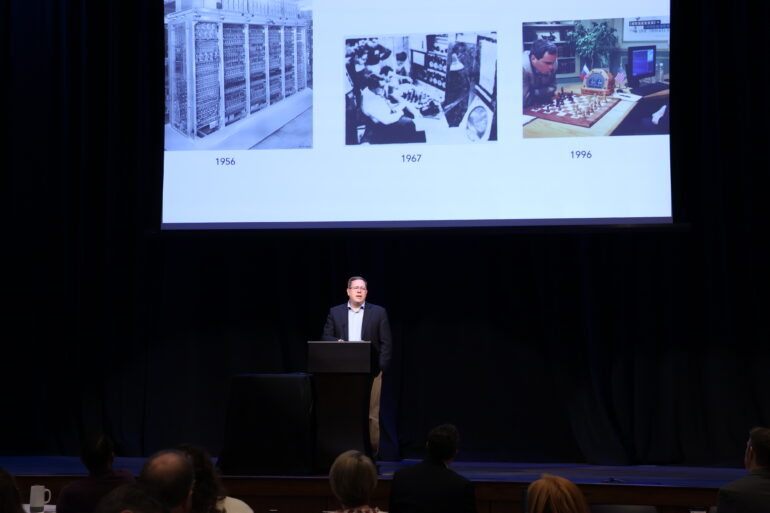

Sponsored by Asbury University and the Asbury Seminary, The Asbury Colloquium featured scholars coming together to join a facilitated discussion. This year’s theme was “Christian Imagination in the Age of AI.” The conference happened from 8:30 to 11:45 a.m. with lunch and fellowship occurring from 11:45 a.m. to 1 p.m. It was held in the CLC Luce Auditorium.
The speakers for the event were from all parts of the university and seminary. They included Mr. Pete Marra, Dr. John Ragsdale, Dr. Jonathan Powers, Dr. Daniel Strait, Dr. Erin Penner, Mr. Michael Heard, Dr. Joel Chopp, Dr. Johnathan Rutledge and Dr. Sherry Powers.
The Colloquium started with a set of greetings to all who attended and then a section called Plenary Talk. Made up of three different speakers, a conversation began regarding Artificial Intelligence (AI) and its relevance to the Christian walk. A point mentioned was about theological vision, the world is sacramental, charged with God’s grandeur. Another was moral formation which is about not just making the right choice, but knowing what is good. Formation happens when friction and struggles happen. Dr. Jonathan Powers said, “Wisdom is grown, not downloaded.”
AI flattens reality, making everything data and predictable. It offers a path devoid of imagination. Dr. Daniel Strait, an English professor at the university, also said in this section, “Imagination begins in place, not abstraction.” The people listening then were asked to have a discussion time at separate tables, being able to share their own thoughts in smaller groups.
After this, the next few sections were rounds of mini papers. The first part of this talked about how in human life, we do not have the ability to avoid pain. Dr. Erin Penner, English professor at the university, said, “I’m grateful we have arms, even if they can be abused.” We as humans need to have stronger confrontation skills and that means of advancement matter. The best way for us to protect our imagination is to prevent human fatigue. AI isn’t inevitable, but humans will eventually get fatigued and give in.
The second part discussed an embodied education, which is helping students recognize the physical consequences of what we learn through our senses. Michael Heard, graduate student at the seminary, said, “Our technological society threatens to divorce us from the ground.” The next two sections were about a similar topic, AI and creativity. The main point was that AI is not a person, but a tool. AI anchors creativity and creates a product that isn’t only made by the person who put in the prompting. Creativity is participatory. We as humans become bolder and stronger when creative.

After hours of discussion, the colloquium’s last section talked about humanity. Imagination comes from experiencing the world through the senses. Writing is an embodied act through which we think. The discussion ended with a grad student attending giving this advice, “We cannot replace humans with convenience.”
If one has questions about future events like this, they can contact the Provost Office at provost@asbury.edu.
Photo courtesy of Alanna May.