

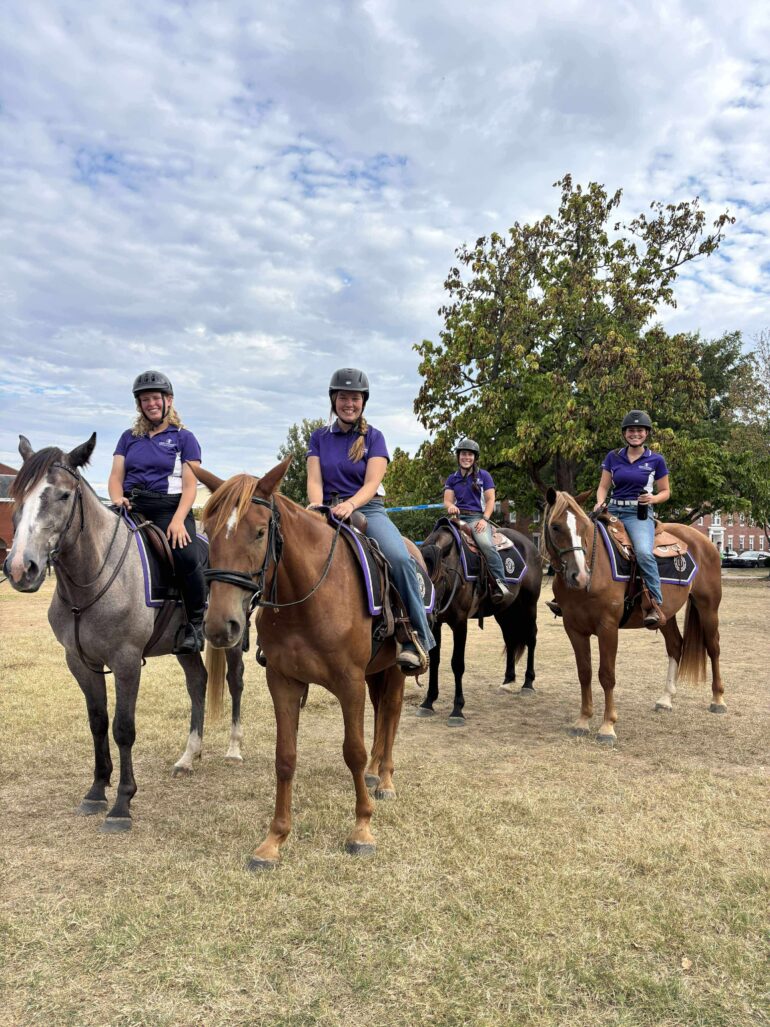

At Asbury University, students aren’t just studying horses — they’re training them to become part of mounted police units across the country.
Through the school’s police horse training program, students take horses from untrained yearlings to equipped service animals capable of working in city environments filled with sirens, crowds and unexpected chaos. The police horse colloquium is an event where both national and international instructors are brought in to the Kentucky Horse Park and both horses and civilians are trained in order to be street ready.
“We start with a lot of desensitizing, introducing them to scary objects, then build up from groundwork to saddling,” student trainer Emma Heiman said. “By the time they’re two, we’re putting weight in the saddle, teaching them to move their shoulders and hips and preparing them for situations they’ll face in police work.”
The process is slow and deliberate. Horses are trained to respond calmly to loud noises, flashing lights and unusual environments. Some clinics include exposure to fire trucks, police cruisers with sirens blaring and even performers blowing fire — all designed to ensure nothing rattles the horses.
“The whole goal is making not just really good horses, but also horses that can be ridden pretty much anywhere and won’t be phased by crowds and are good under pressure,” another student trainer Ruth McDearmon said. “In the equine world, that’s called a bombproof horse.”
The program is a major draw for equine students, many of whom specifically choose Asbury because of the Police Horse program’s uniqueness. Unlike most universities, Asbury allows students to train a horse from the time it is a weanling until the student’s (or the horse’s) graduation.
“It’s the only university I know that has a program like this,” Heiman said. “That’s why people come here for the police mount program.”
Students often develop deep bonds with their horses before the animals leave for assignments with police units. One horse, Patton, has already been bought and is headed to Louisville to join the force. Another, Pippin, a three-year-old Belgian draft-quarter horse cross, will join the Milwaukee Police Department next spring.
“I’ve been working with him since he was a yearling,” McDearmon (Pippin’s trainer) said. “It’s sad he’ll graduate before me, but it’s rewarding to see him ready to serve.”
The program isn’t without challenges. Students must dedicate a minimum of 10 hours a week to training, balancing their coursework and often jobs. The work is physically demanding, especially during Kentucky winters, and emotionally taxing when horses struggle to learn new skills.
“It’s a lot of patience,” McDearmon said. “At first, these horses might be scared of you. Over time, you build trust, and that’s what makes it worth it.”

Faith also plays a central role, integrating spiritual development into the equine program. Students say their mentors not only guide them in horsemanship but also pray for them regularly.
“We have a saying: God, people, horses — in that order,” Heiman explained. “It’s not just about performance. It’s about faith, service and giving these horses a purpose.”
In the end, the hard work pays off. They leave the program with valuable career connections, lifelong friendships and the knowledge that they’ve helped transform once-untrained horses into public servants.
“All the long hours and frustration make the reward even greater,” McDearmon concluded. “If the challenges weren’t there, the reward wouldn’t mean as much.”
Photo courtesy of Police Horse.
