


By the time students step away from the gates of Auschwitz, many are silent.
Some have walked for hours through barracks and ruins. Others struggle to reconcile with what they have seen with what they thought they knew. For David Kennedy, that silence is not an ending. It is the beginning of the work.
Kennedy, an American-born educator who has spent much of his life in Poland, works at the International Youth Meeting Center in Oświęcim, known to the world by its German name: Auschwitz. The center sits between Auschwitz I (the original town) and Auschwitz-Birkenau, physically and symbolically positioned between past and present.
“This is a place where people come not just to learn history,” Kennedy said, “but to confront what it asks of them now.”
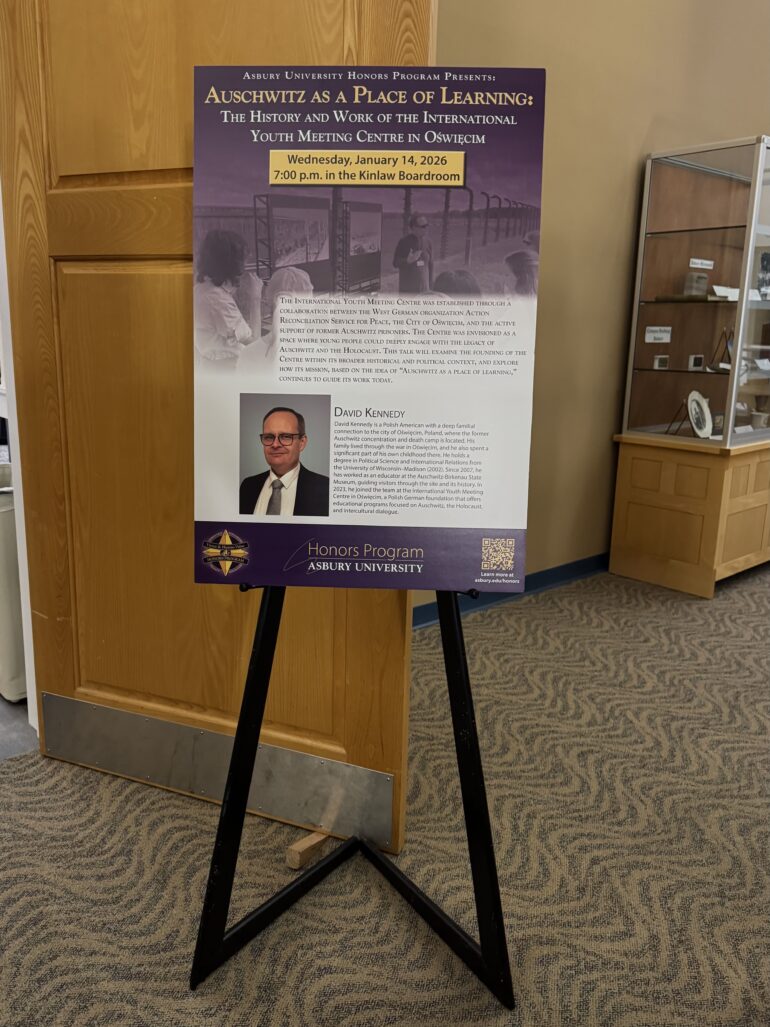
Kennedy spoke to students at Asbury on Jan. 14, emphasizing the relationship between historical knowledge and human responsibility. His visit followed years of collaboration with study-abroad programs that bring students face-to-face with sites of atrocity and survival.
Those encounters, faculty members said, are often among the most difficult and transformative experiences students have.
During past study tours, students spent hours walking through former concentration camps, absorbing evidence of what Kennedy calls “the most dramatic documentation of human brutality ever recorded.” Yet what struck many was not only the facts, but the way they were presented.
“He walks people gently through an indescribably sorrowful history,” one professor said. “He creates space for students to confront what people are capable of doing to one another, without stripping away humanity.”
Kennedy’s work is rooted in personal history. His family has lived in Oświęcim for generations. Although he was born in the United States, he returned to Poland seeking to understand a past his grandparents rarely spoke about. Like many residents of the area, they lived alongside the camps, witnessing forced labor, deportations and violence that shaped the town forever.
Auschwitz was not a single site, Kennedy explained, but part of a vast network. Between 1940 and 1945, at least 1.3 million people were deported there. Approximately 1.1 million were murdered. Ninety percent were Jewish. Others included Poles, Roma and Sinti people, Soviet prisoners of war, and victims from across Europe.
Quoting a survivor, Kennedy said, “Yet the Holocaust did not “fall from the sky, it was constructed over time, through policy, propaganda and human choices.”
The International Youth Meeting Center was created to help visitors understand that process. Established in 1986, more than 40 years after the war, the center emerged from decades of political tension, Cold War division and difficult reconciliation between Germany and Poland.
Its founders believed education had to happen near the site itself, but not within it.
“This is not a museum,” Kennedy said. “It’s a place for dialogue.”
Groups from across Europe and beyond stay at the center, participating in workshops before and after visiting the camps. They learn about prewar Jewish life in Oświęcim, where more than half the town’s twelve thousand residents were Jewish before nearly all were murdered. They explore how ordinary cities became sites of genocide, and how memory is shaped after violence.
The center’s design reflects its purpose. The buildings are simple and light-filled. There are seminar rooms, a library, a gallery, gardens and a House of Silence, where visitors can pray, meditate or sit quietly. There are no televisions in the dormitories.
“It’s intentional,” Kennedy said. “This work requires presence.”
Art, sports and cultural events are also part of the center’s mission. Local residents use the space, bridging the gap between global history and everyday life. For Kennedy, that connection matters deeply.
“Memory cannot exist only for visitors,” he said. “It has to live in the community.”
Kennedy embodies that bridge. Trained in political science and international relations, he chose to live and work in Poland, integrating American and European perspectives. Colleagues describe his work more as a calling than a profession.
One detail, shared during his introduction, stayed with many listeners: Kennedy makes eye contact with every person he speaks to.
“He meets people where they are,” a faculty member said. “When students wrestle with the hardest questions of history, he treats that struggle as human, not abstract.”
That approach reflects the philosophy behind the organization that helped found the center: Action Reconciliation Service for Peace, a German volunteer movement created in the postwar years. Its founders believed reconciliation required acknowledgment, responsibility and sustained effort.
“We Germans started the war,” one founder wrote. “Those of us who survived did not do enough.”
For Kennedy, those words still resonate.
“Auschwitz demands historical awareness,” he said. “But awareness alone is not enough. The question is what we do with it.”
As students filed out of the lecture hall, they knew there would be time for questions. But many lingered in silence, contemplating injustice, cruelty and dignity, past and present.
Coming to such a talk, one professor noted, “it takes a certain kind of bravery.”
“So does remembering,” Kennedy said.
Photo courtesy of Alanna May.
