

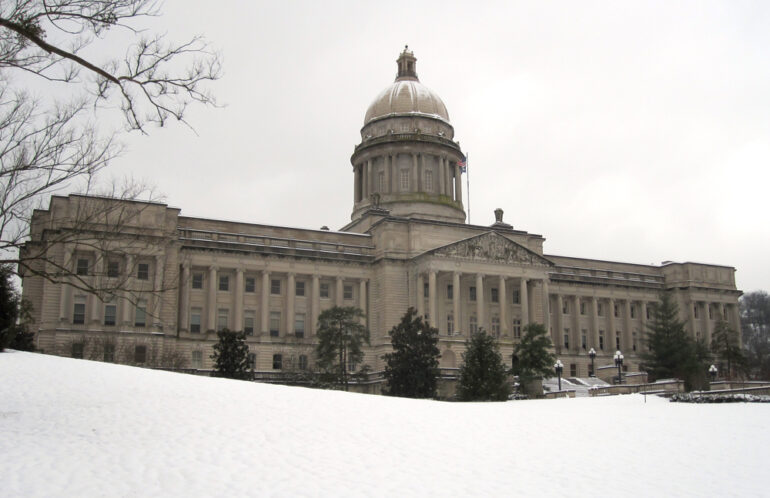

On Nov. 1, Kentucky’s first and only female governor, Martha Layne Collins, passed away. According to a statement from Sen. Mitch McConnell, Collins “was known for breaking barriers.” While government elected offices remain a male-dominated field, Kentucky has a long history of women serving in office, dating back to 1921. Collins was preceded by women who helped open doors in state government, inspired others to step forward after her election and set a precedent for future generations of Kentucky women to continue to lead.
There were many Kentucky women who were active participants in the women’s suffrage movement and shortly after women gained the right to vote, the first Kentucky woman was elected to office. In 1921, Mary Elliot Flanery became the first woman elected into the General Assembly where she advocated for education and social reform.
Emma Guy Cromwell, elected Secretary of State in 1923, went on to serve as State Treasurer and made an early run for governor in 1927. Other trailblazers followed, like Thelma Stovall whose career in Kentucky politics spanned over more than 20 years where she served as Secretary of State, Treasurer and eventually Lieutenant governor. She was also appointed as a member emeritus of the Kentucky Commission on Women by Governor Martha Layne Collins.
Frances Jones Mills, Mary Louise Foust and later Crit Luallen, who served as State Auditor and Lieutenant Governor, continued to expand women’s roles in state government. Each of these women helped build the political infrastructure that paved the way for Collins’ election in 1983.
Collins, a former teacher from Shelby County, served as lieutenant governor before winning the governor’s race in 1983. Her four-year term focused heavily on education and economic development. Collins pushed for education reforms, mandatory kindergarten and even established the well known Kentucky Governor’s Scholars Program to help encourage high-achieving students within the commonwealth. She is perhaps best remembered for recruiting Toyota to build its Georgetown assembly plant, a historic deal which transformed Kentucky’s economy.
“When I became governor, you have lots of priorities, but when I’d sit down and think about it, education always came back as the first thing you have to start with,” stated Collins in a 1992 interview with the Nunn Center for Oral History at the University of Kentucky. “I feel like I made an impact in education and bringing in new jobs; I hope we made the people of Kentucky feel good about themselves.”
Today, women continue to shape Kentucky politics. Lieutenant Governor Jacqueline Coleman serves alongside Gov. Andy Beshear and has cited Collins as one of her inspirations. Allison Ball, who first served as State Treasurer and now as State Auditor, is yet another example of a woman holding statewide executive office.
Women have also risen in Kentucky’s judiciary. In 2025, Debra Hembree Lambert became the first woman to serve as chief justice of the Kentucky Supreme Court, marking another historic milestone for the commonwealth.
Women throughout the commonwealth have more opportunities to pursue roles in advocacy and public service than ever before, thanks to the women that came before them.
Students who are interested in careers in public service don’t have to wait until they have established careers to begin getting involved in politics. Programs like the Team Kentucky Internship, which places college students in paid state government internships, give young Kentuckians firsthand exposure to public service.
During budget years, the Legislative Research Commission hires interns who get the opportunity to work in Kentucky’s capitol during the legislative secession to gain an understanding of the legislative process and public policy.
Political organizations such as the Kentucky Young Democrats and College Republicans also help students learn the mechanics of campaigning and policymaking.
Initiatives such as Emerge Kentucky train and mentor Democratic women interested in running for office, while similar efforts within Republican circles encourage young conservative women to seek leadership roles.
Now more than ever, women have many opportunities to seek leadership roles as well as role models in many areas of public services.
The life and legacy of Martha Layne Collins reminds us that anyone, even a woman from a rural town in Kentucky, has the power to make change. Although Collins remains the only woman to have served as governor of Kentucky, generations of women have served and will continue to serve in the legislature, courts and statewide executive offices.
Through the women that have paved the way for women in public service, the next generation is already preparing to enter into careers in public service. While Collins remains Kentucky’s only female governor, her legacy ensures that she will not be the last.
Photo courtesy of KY.Org.
